Safety
Safety architecture
The safety design rests on one principle: hard limits live in code and files outside any model, and every failure mode blocks the trade instead of allowing it.
1. Deterministic risk engine (crew/risk.py)
Every order intent passes through RiskEngine.check() before a paper fill can happen.
- Fail closed. The check runs with a timeout. If it times out, raises an exception or returns the wrong type, the order
is vetoed with a reason that starts with fail-closed:.
- At-limit counts as a breach. Comparisons use >=, so an exposure exactly equal to a cap is rejected.
- Decimal only. Non-Decimal numeric inputs are rejected, which caught a real bug during development (an empty sum()
returned an int).
- Limits come from config/limits.json and are loaded read-only, together with their SHA-256 hash. A LimitsAuditor
re-hashes the file and logs LIMITS_FILE_CHANGED as a critical risk event when the file is modified. The API refuses any
attempt to change limits at runtime and writes that attempt to the audit log.
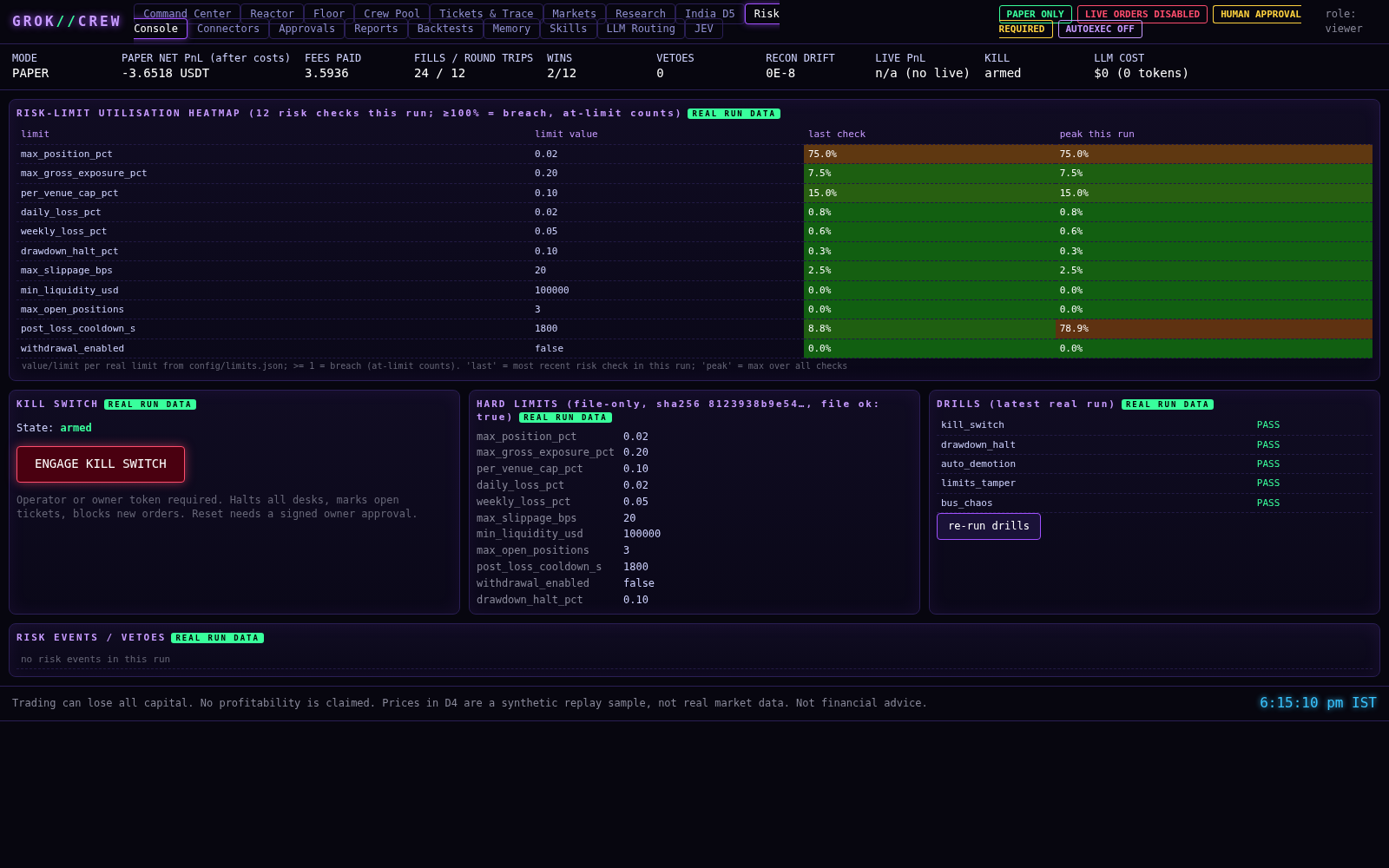
The limits currently in config/limits.json:
| Limit | Value |
|---|---|
| max position (fraction of equity) | 0.02 |
| max gross exposure | 0.20 |
| per-venue cap | 0.10 |
| daily loss | 0.02 |
| weekly loss | 0.05 |
| max slippage | 20 bps |
| min liquidity (24h quote volume) | 100,000 USD |
| max open positions | 3 |
| post-loss cooldown | 1,800 s |
| withdrawals | disabled (false) |
| drawdown halt | 0.10 |
2. Kill switch (crew/killswitch.py)
An operator or owner can engage the kill switch from the Risk Console or with POST /api/kill. It blocks new paper orders
and marks open tickets. Order submission and kill acknowledgment are serialized. This replay/paper build does not own a
live position or exchange connection, so the kill switch does not flatten external positions. The latest kill state is
recovered from the append-only audit journal across run IDs after a restart. Only the owner can clear it through
POST /api/kill/reset, which applies an HMAC-signed kill:reset approval and requires TOTP when configured.
Automatic daily-loss kill. When the risk engine sees a daily-loss breach (at-limit counts) it only returns a veto with
the reason daily loss limit breached; the risk worker has no side effects. The engine then engages the global kill on its
own event loop through the same engage_kill path as POST /api/kill: every desk is halted, open tickets are
cancelled/expired, and a KILL risk event plus an audit row (actor risk-engine:auto) are written to the store under the
run's run_id. Fills are serialised against kills: the kill state is re-checked under a lock immediately before any paper
fill is recorded, and a fill that loses the race is discarded. Neither a new trading day nor a process restart clears the
kill. The latest kill state is recovered from the append-only audit journal across run IDs. Only the owner can clear it
through POST /api/kill/reset, which persists an HMAC-signed kill:reset approval before clearing it and requires TOTP
when configured.
Daily loss is mark-to-market. Daily PnL = (cash + open positions marked to the fixture bid) − equity at the start of the
UTC day (the last mark before 00:00 UTC; the start equity on the first day). It therefore includes realized and unrealized
PnL and all fees. The limit is breached when -daily_pnl >= daily_loss_pct × min(start-of-day equity, current equity)
(at-limit counts, like every other limit). Two paths use the same pure function risk.daily_loss_breached:
the pre-trade risk check, and a per-tick open-position monitor in the engine that records a DAILY_LOSS_MTM risk event and
calls the same engage_kill (actor risk-engine:auto) even if no new order is attempted. The weekly check adds unrealized
PnL to realized PnL. On the bundled sample this changes nothing (Track 1 stays at −3.6518, 24 fills, 0 vetoes); tests in
tests/test_mtm_daily_loss.py crash a test copy of the fixture to prove an open, unclosed position triggers the kill.
Risk input validation. The risk engine rejects, with a fail-closed: ... reason, any non-Decimal, NaN or ±Infinity
value; negative notional, slippage, liquidity, gross or venue exposure; non-integer or negative position counts; venue
exposure larger than gross exposure; and a bad start-of-day equity. Timeouts, worker exceptions, malformed decisions,
a kill engaged while the check ran, and limits swapped in memory (digest check) all reject.
3. Signed approvals (crew/models.py)
Owner approvals are HMAC-signed with a key read from the CREW_APPROVAL_HMAC_KEY environment variable. Without the key,
approvals cannot be signed. A signed approval is necessary but not sufficient: the promotion gates still apply.
4. Append-only storage (crew/store.py, crew/memory.py)
The trace, ledger, risk events, audit log and shared memory are append-only. In SQLite, BEFORE UPDATE and BEFORE DELETE
triggers raise an error. In Postgres, a PL/pgSQL trigger function does the same. All writes go through a process-wide lock.
5. Authentication and roles (crew/auth.py, crew/api.py)
- Three roles: owner (view, research, approve, kill, mode change, config), operator (view, research, kill) and viewer (view).
- Tokens come from environment variables only and are accepted only in the
Authorization: Bearerheader. Tokens in the URL are rejected, and the UI removes them from the address bar. - The WebSocket authenticates with a first message
{"auth": "<token>"}sent within 5 seconds. - Optional TOTP (time-based one-time password) for owner actions: set
CREW_OWNER_TOTP_SECRETand send anX-TOTPheader. It is disabled when the variable is unset.
6. LLM isolation
tests/test_brain.py::test_no_llm_path_reaches_order_risk_mode_code parses the source of every decision module (risk, modes,
kill switch, engine, connectors, desks, overseer, models, bus, store, agents, drills, skills, backtest) and fails if any of
them imports the LLM router, JEV or memory-read functions. The engine only writes deterministic facts to memory; it never
reads them back.
7. Secrets policy
- No keys in code, chat or command-line arguments.
- Secrets live only in
.env, which is gitignored;.env.examplelists the variables with empty values. - The application needs no exchange keys at all, and no key may ever have withdrawal permission.
Observability, run isolation and data guards
Run isolation (run_id).
- Every row in the trace, ledger, risk events and audit log carries the store's run_id (a UUID).
- Keys and indexes:
- SQLite: trace has the composite primary key (run_id, trace_id); every table gets a unique index on (run_id, seq|trace_id) and an index on run_id.
- Postgres: the same indexes are added.
- All reads behind drift, wins and net PnL are scoped to the current run_id, so two runs sharing one database cannot
pollute each other. Tests run two concurrent paper days on one SQLite file (and on Postgres), and each matches an isolated run.
- Migration. Older databases get run_id added with ALTER TABLE ... ADD COLUMN ... DEFAULT 'legacy', so older rows
stay readable under the legacy run.
- Concurrent setup. Schema creation is serialised: an in-process lock with a SQLite busy timeout, and a Postgres advisory lock.
LLM metering.
- The router records prompt_tokens and completion_tokens from each provider response's usage field.
- Cost is computed only from config/llm_pricing.json. Those prices were copied on 2026-10-20 from the public OpenRouter and
Kilo model-list APIs, and each entry records its source URL. All configured models are free (price 0).
- Any other model, or a response without usage, is costed as UNKNOWN and is never guessed.
- The header's LLM cost combines the engine's 0 calls with the router's real totals.
Prometheus metrics: GET /api/v1/metrics.
- Requires a viewer token. In Prometheus, set authorization: {type: Bearer, credentials_file: ...}; keep the server bound
to localhost or behind a reverse proxy.
- The registry is built fresh on each scrape from the current run's telemetry. Series:
- crew_intents_submitted_total;
- crew_rejects_total{reason} (no_quorum, risk:<reason>, stale_data:<why>, kill_switch);
- crew_risk_breaches_total;
- crew_quorum_outcomes_total{outcome};
- crew_signal_to_decision_seconds (histogram of wall time from signal to ticket decision);
- crew_kill_switch_engaged;
- crew_mode_info{mode,run_id};
- crew_bus_dlq_size{source="drill"}. This comes from the last bus_chaos drill, because the runtime engine has no message bus.
- In the reference run: 86 signals, 74 rejected for no quorum, 12 intents submitted, 0 risk breaches.
Offline order book and feed guard (crew/orderbook.py).
- L2Book validates the book (sorted, positive, not crossed) and gives spread, depth (optionally within N bps of mid) and a
VWAP fill-cost estimate with impact versus best price and versus mid. It is tested on the replay fixture.
- StalenessGuard blocks signal evaluation when a symbol's data gap exceeds max_gap_s, when timestamps go backwards, or
when exchange time drifts from local time by more than max_drift_s. The settings are in config/feed_guard.json
(120 s and 5 s); they are not risk limits.
- It is wired into the D4 replay. The bundled fixture has no gaps, so it never fires there and results are unchanged.
- A test injects a 10-minute gap and checks that evaluation is blocked.
- Live market-data feed. The Market page may connect to Binance public Spot REST and WebSocket endpoints without API keys. It is display-only; it is not an account feed, it does not enter the paper strategy pipeline, and live quotes are not used to calculate replay fills or PnL.
Charts.
- The Markets page shows live Binance Spot OHLC candles in TradingView Lightweight Charts™ v5.2.1 (vendored unmodified, Apache-2.0; see web/vendor/lightweight-charts/NOTICE). Replay fills remain in a separate, explicitly synthetic panel. Showcase charts and paper KPIs are likewise separate.
- The Risk Console has a limit-utilisation heatmap: value divided by limit for every real limit in config/limits.json,
at the last risk check and the peak over the run (≥ 100% means a breach, and at-limit counts).
Testing and drills
.venv/bin/pytest -q tests                                       # unit, integration and API tests
TEST_DATABASE_URL=postgresql://... .venv/bin/pytest -q tests    # also runs the Postgres tests
/workspace/.pwvenv/bin/python -m pytest tests_e2e               # Playwright smoke test of all 19 pages (needs playwright)
.venv/bin/python scripts/run_drills.py                          # safety drills; exits non-zero on failure
What the test suite covers: - the ticket state machine; - risk at-limit breaches and fail-closed behaviour; - limits tampering; - signed approvals; - the mode gates; - the bus (leases, idempotency, dead-letter queue, backpressure); - the append-only triggers; - paper reconciliation; - RBAC, header-only auth, WebSocket first-message auth and TOTP; - shared memory, the router (no key, and fallback), JEV refusals and LLM isolation; - the skills; - agent wiring; - the JSON Schemas. - read-only public market-feed validation, candle aggregation, API authentication and allowlist enforcement.
CI (.github/workflows/ci.yml) runs pytest against a Postgres service (REQUIRE_POSTGRES=1 makes the job fail if the Postgres tests would be skipped), then the drills and a paper day.
Drills (crew/drills.py), all PASS in the latest run:
1. kill_switch: blocks new paper orders and marks open tickets. No external positions can be flattened by this paper-only build.
2. drawdown_halt: passes at 5% drawdown, blocks at 10%, and the block persists.
3. auto_demotion: LIVE_APPROVAL → PAPER → REPLAY.
4. limits_tamper: a modified limits file is detected.
5. bus_chaos: duplicates, a simulated 429, lease timeouts, the dead-letter queue and backpressure are all handled.
6. daily_loss_kill: runs the real paper day with the risk engine fed an at-limit daily loss from the third order intent;
the kill engages once, halts every desk, writes one KILL risk event and one audit row, no further fill is recorded,
and an unsigned reset is refused.
Audit summary and known limitations
The full audit, with file and line references, is in reports/AUDIT.md. It lists 35 items:
- 23 fixable offline: fixes are recorded inline in the audit table.
- 8 blocked by needing real data, verified evidence, or credentials.
- 11 intentional safety stubs.
- 1 uncategorised: "Jev-Claw", which could not be identified.
Known limitations, stated plainly:
- Data. The optional read-only Binance public market feed provides live quotes/candles for display only. All strategy evaluation, fills, backtests and PnL remain synthetic or replayed. No account, private stream, order or testnet connection exists.
- Unverified assumptions.
- the 10 bps Binance fee rate;
- the 2% prediction-market fee;
- the SEBI threshold of 10 orders per second;
- no connector's venue documentation has been verified.
- India D5. No verified blackout calendar exists, so every entry is blocked.
- Quorum. The D4 quorum is effectively one independent lane (see the S10 note above).
- Redis. The Redis adapter has been tested only against fakeredis, and the runtime engine does not use it.
- Docker. docker compose and app-to-Postgres networking inside Docker are not yet verified.
- LLM cost metering has been tested only with mocked provider responses. No real provider call has been made, because
no key is configured.
- Agent names. S24–S50 have inferred names.